


These are learning notes from my explorations and classes on embodied anatomy. I give myself 30 minutes to write these up before my lessons.
Recall that we can separate nerves in the nervous system into two fundamental types: sensory (carrying information to the central nervous system), and motor (carrying information from central nervous system to muscles for movement).
Last week we covered the trigeminal nerve, which is the main sensory nerve that carries information from your face to your brain (it does have motor components going to the jaw).
This week let’s talk briefly about the facial nerve and the vestibulocochlear nerves.
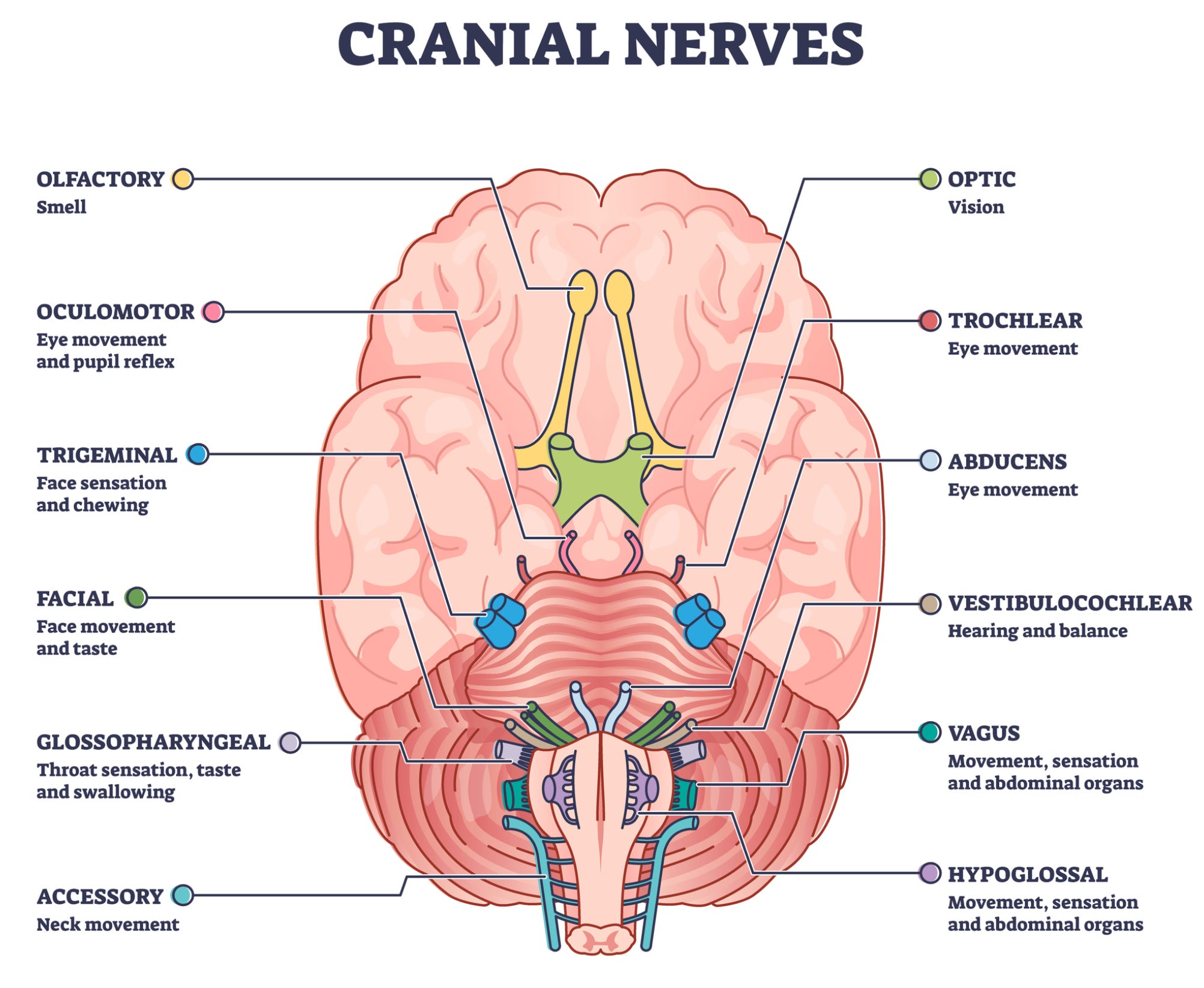
The trigeminal nerve carries sensory information.
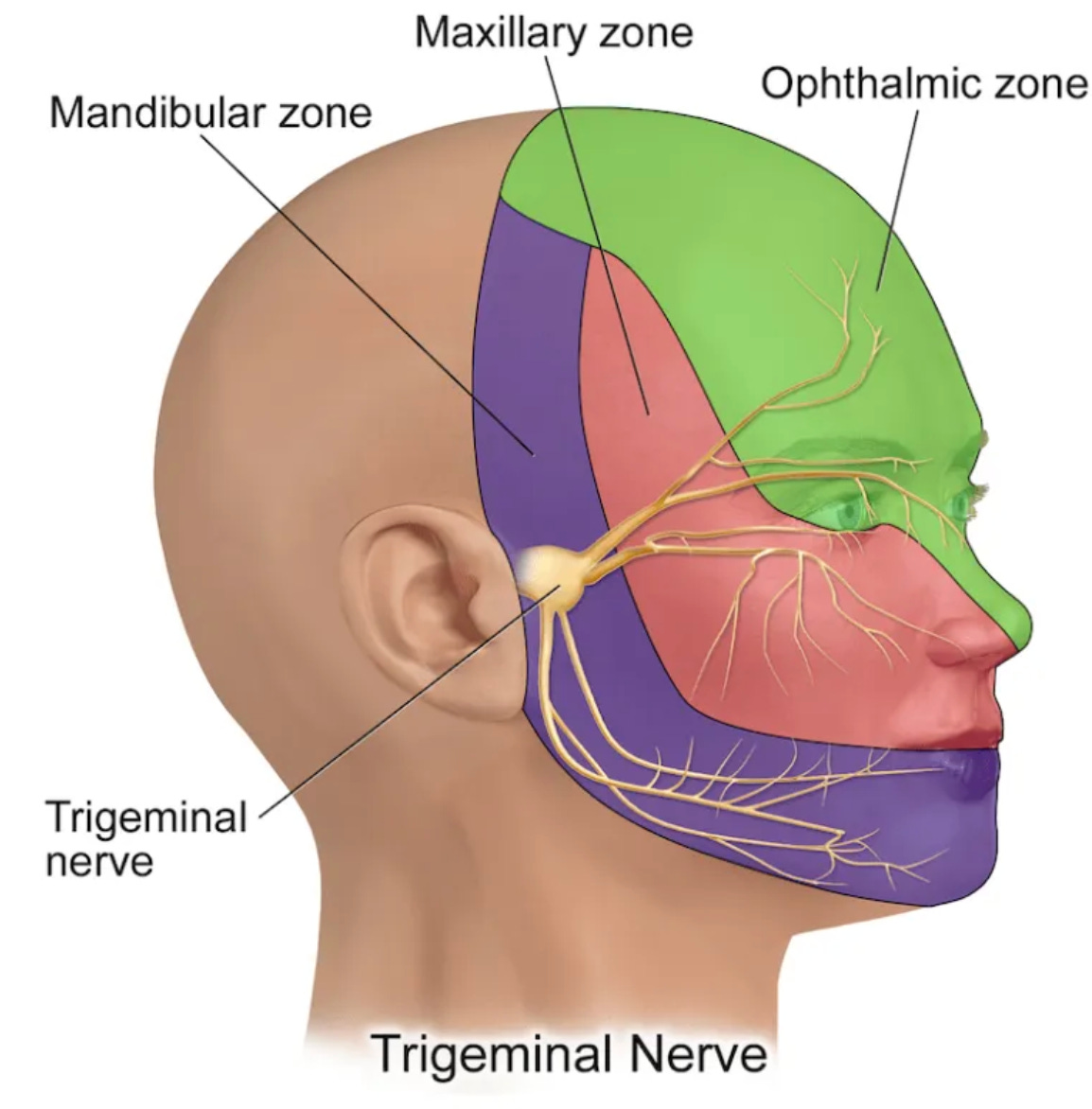
The facial nerve carries motor information.
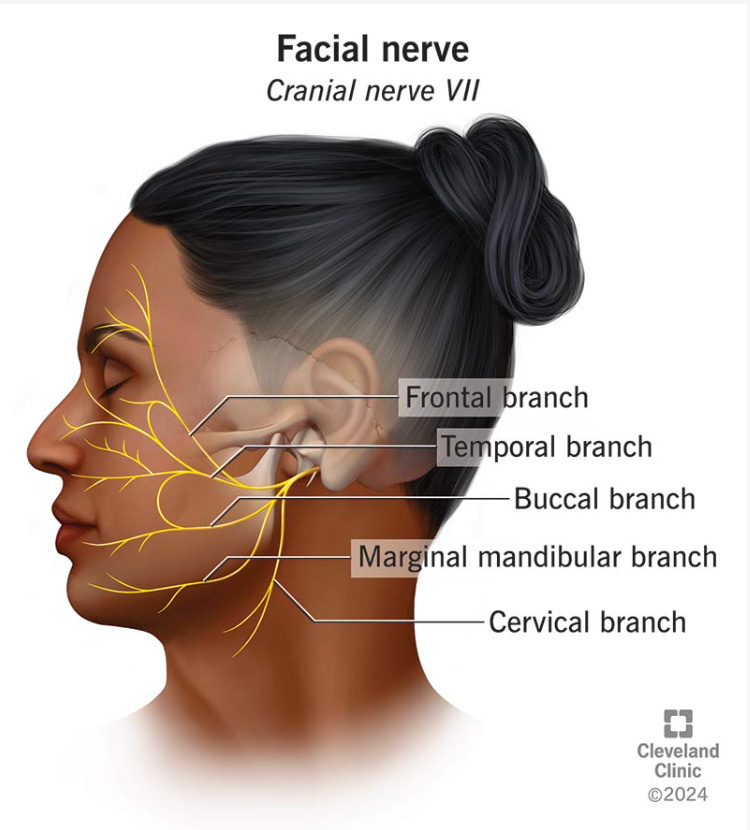
Both richly ennervate your face; if you sense your face, you are mostly using the trigeminal nerve. If you scrunch your face up, you are using the facial nerves.
Exercise: FEELING THE FACIAL NERVE
Try slowly smiling, bringing your cheeks out wide. See if you can feel the connection of the cheeks (buccal branch of the facial nerve) to right below the ears (root of the facial nerve). Now try scrunching your forehead. Can you feel a line of connection from your forehead to the base of the ear?
Oh boy, time for the vestibulocochlear nerve.
The whole hearing and balance system is marvelously sophisticated and its own field of study (there are thousands of audiology PhDs each year), but here is the briefest of brief overviews.
The basic anatomy of a sound registering to the central nervous system:
Air particles vibrate the eardrum, small bones in the middle ear transmit vibration to a shell structure in the inner ear (cochlea),
Fluids move along the shell structure, and mechanoreceptors (little filament hair cells) get deflected and fire, activating the vestibulocochlear nerve in the brain
Importantly! The sense of sound is constructed. You can experience this in meditation, but also with some simple audio illusions.
The parameters of ‘distance’ (notice the cars on the street may feel further away than the fan in your room) and ‘pleasantness’ (listen to bird song vs construction work) feel ‘baked in’ to the sound, but they are inferences our central nervous system makes. Sound has no inherent distance nor valence.
Out of time to describe a full exercise, here is a fun video that shows how sound is constructed.
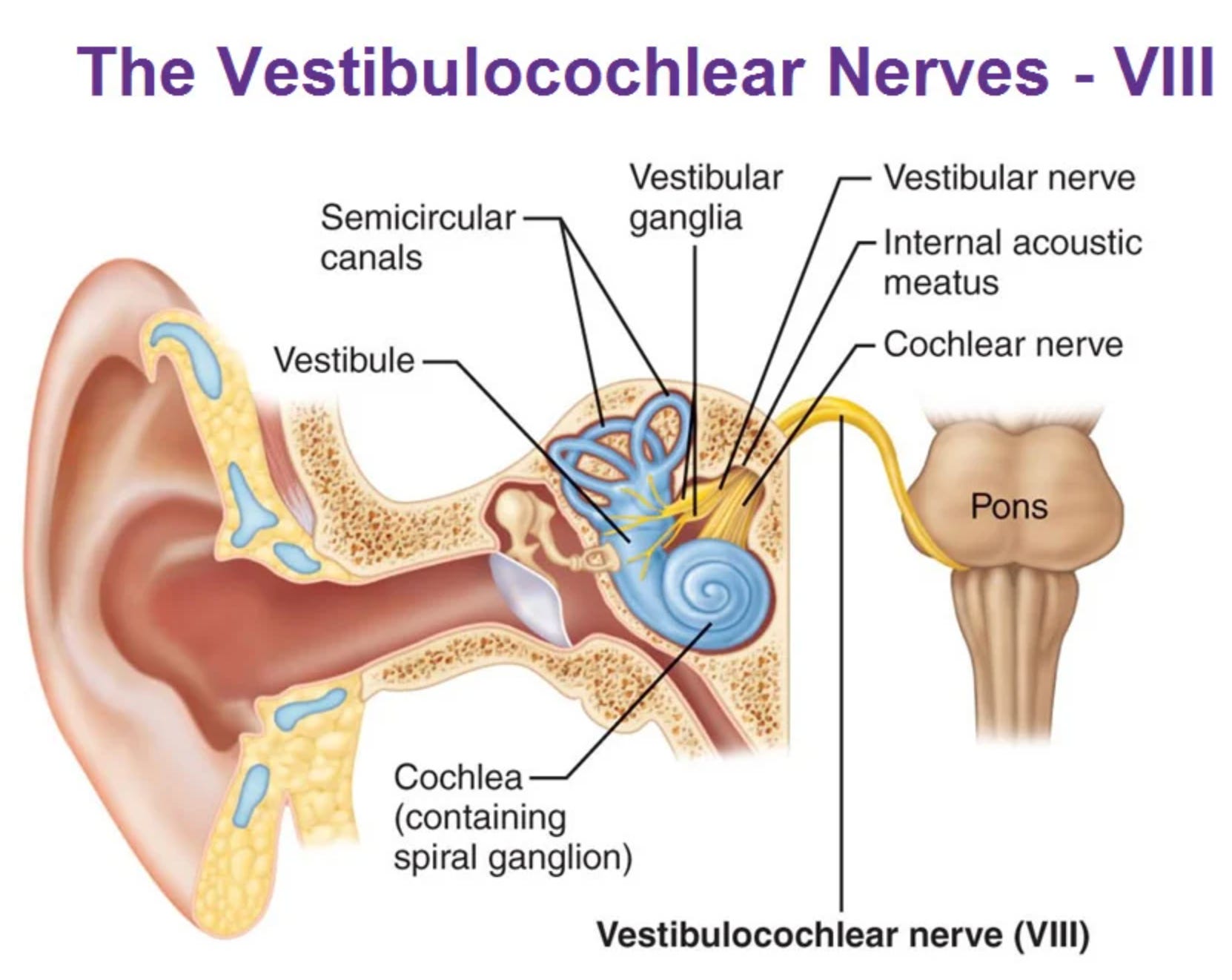
Semicircular canals help with orientation (three curls help with x y and z axes! and there is specialized apparatus to detect linear vs nonlinear acceleration) - Very cool stuff. for further rabbit holing, look at the Moro reflex and role of inner ear, and eye tracking reflexes
See you next time!