


This recent opinion piece by Kotler, Mannino, Fox, and Friston is interesting.
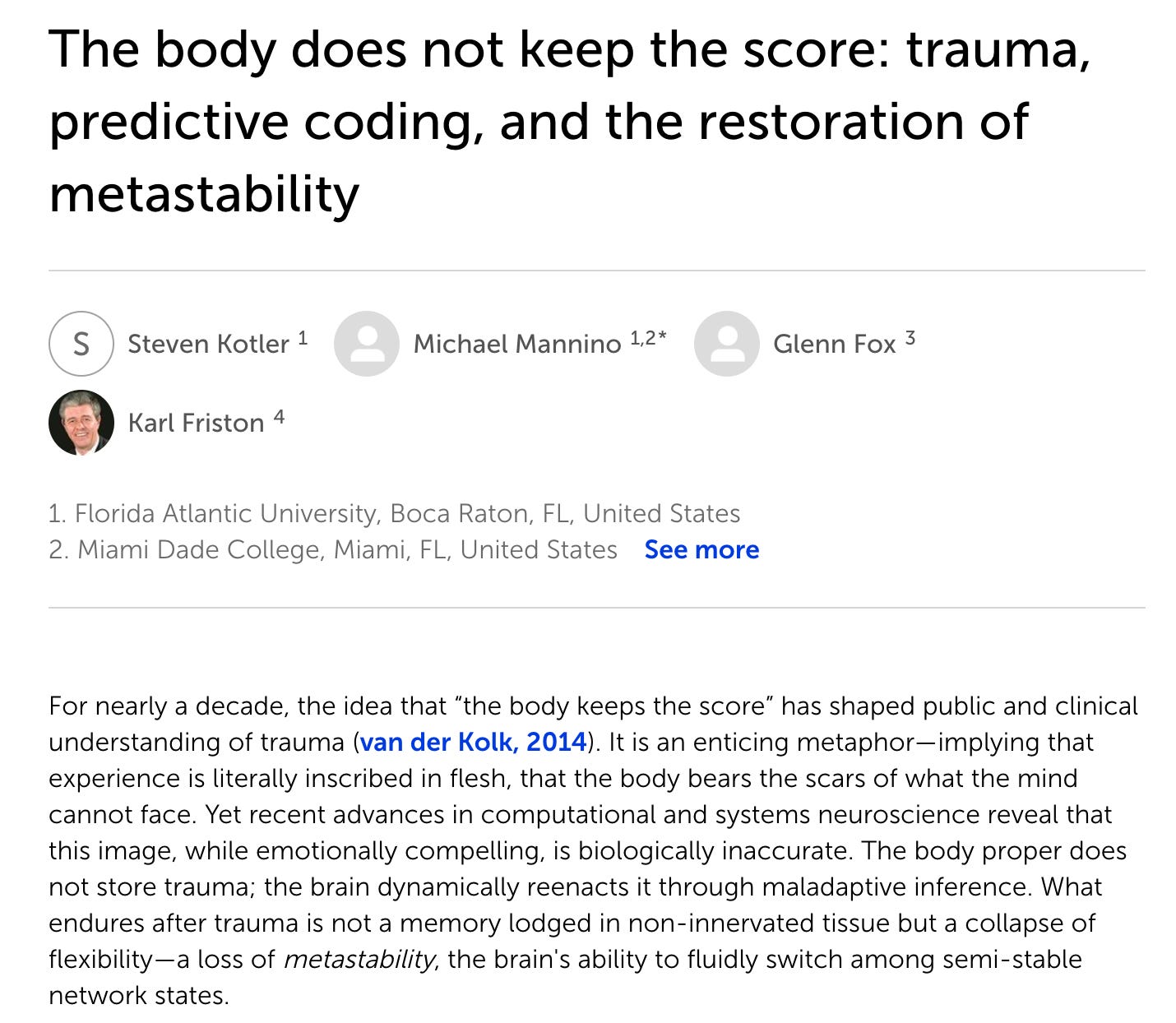
Their basic claim is “trauma is more like a trapped prior than an inscription.” Trauma is a maladaptive lack of responsivity, not like a bullet wound or physical injury. But there are at least two parts to the debate here:
Anti-inscription — their main argument: we should not think about trauma as something that is stored and accumulated (they are basically pushing back against the “storehouse model” of trauma).
Brain-only — trauma is in the brain, not the body.
They smuggle in “brain-only” when really they are arguing about “anti-inscription.” But we can look at these in turn.
I think anti-inscription is basically right.
Van der Kolk’s The Body Keeps the Score is vague on what constitutes trauma. “The score” he refers to is about debt, like an accounting debt, but he also uses metaphors like “watchtower” and “smoke detector” throughout the book — though the end message is that you need to get into the body to resolve the stored trauma.
Kotler et al. say that this is wrong. You shouldn’t see the body as “storing” trauma. Most people don’t get PTSD from war, death of a spouse, etc. (though very many do) — which would not happen if it were permanently inscribed in the body.
(Note: I doubt anyone, including van der Kolk, believes that trauma is permanently inscribed in the body; “watchtower” and “smoke alarm” are pretty compatible with the trapped prior view of trauma.)
Instead, Kotler et al. say that trauma is about a stuck prediction — “loss of metastability — the brain’s ability to fluidly switch among semi-stable network states.” They try to relate everything to free energy minimization — a move that I’ll just note confuses more than clarifies things for me.
This is basically compelling, and I do think “trapped prior” is far better than “storehouse” for how to think about trauma.
Then they basically try to explain that because trauma is about predictions, it must be about the brain (which they use interchangeably with the central nervous system).
My basic objection to this is that it is experientially obvious that memories in general — not just trauma — involve parts of the body outside the central nervous system. Very obviously, the enteric nervous system and cardiac neurons encode memory that can be linked with trauma.1 More speculatively, it clearly feels like specific regions of fascia and smooth muscle can be said to act as a prior.
Annoyingly, this whole piece feels like an old rehash of the perennial mind-body debate, where the predictive processing people are insisting “trauma is in malformed prediction (mind)” and the somatic people insist “trauma is in the viscera (body).”
The way forward is what the somatic scientists like Thomas Hanna and Feldenkrais gestured at2 — which I think in principle the PP people should be on board with, but probably in part because there isn’t yet a mature science of somatic memory, they tend to default to reducing everything to the brain.
On the ENS side, see Furness et al., “Memory in the Enteric Nervous System,” Gut (2000), which reviews evidence for habituation, sensitization, and long-term facilitation in enteric neurons. On the cardiac side, see Mando et al., “The Intrinsic Cardiac Nervous System,” J. Cardiovascular Development and Disease (2024), which documents neuronal plasticity and memory capacity in the ~40,000 neurons of the heart’s intrinsic nervous system.
A student of Feldenkrais, Thomas Hanna was a philosopher-practitioner who coined the term "somatics" in 1976 and developed Hanna Somatic Education around the concept of sensory-motor amnesia — the idea that movement and body memory get chronically "stuck" in ways that require somatic re-education to resolve, not just top-down cognitive intervention.
I also think you’re being a bit unfair by lumping them under “it’s all in the mind”. The phrase “somatic marker” was new to me and a good encapsulation of the difference between what they’re saying and an either-or. From the individual’s subjective point of view it’s the same whether information is literally stored/encoded in parts of the body, or in parts of the CNS through which we experience those body parts. So they’re not saying don’t work with the body…
I think there were a lot of really great things in this essay, maybe too many—can you tell five people wrote it? lol—and setting it up to be anti-van-der-Kolk was probably the weakest part. It’s really a kind of technical point they’re making, though they do name some practical pitfalls of taking the “stored in the body” frame too rigidly.
I love all articles that kick dust on popular notions. The idea that trauma accumulates in the body makes trauma seem like a huge hurdle and something that necessarily is difficult to overcome. It also emphasizes that we aren't in control of ourselves.